
Andrew
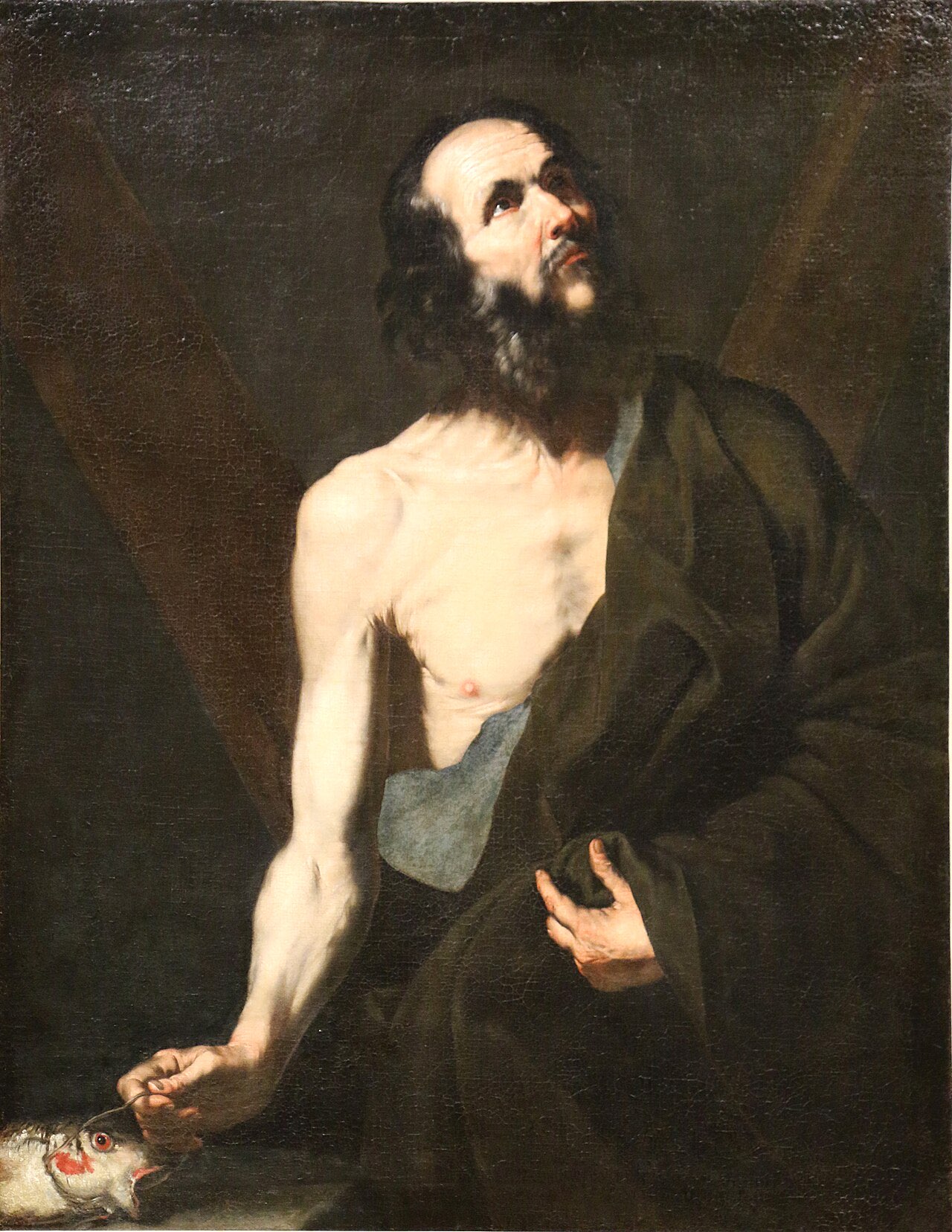
Andrew of Bethsaida holds a title the church never forgot: protokletos, the first-called. A fisherman and a disciple of John the Baptist, he was standing beside his teacher when John pointed at a passerby and said, “Behold, the Lamb of God!” Andrew followed, spent the day, and then did the thing that became his signature: “He first found his own brother Simon and said to him, ‘We have found the Messiah’… He brought him to Jesus” (John 1:35-42). The man who brought Peter to Christ arguably changed history as much as Peter did.
John’s Gospel shows him doing it twice more. At the feeding of the five thousand, it is Andrew who produces the boy with five loaves and two fish – adding, honestly, “but what are they for so many?” (John 6:8-9). When Greeks come asking to see Jesus, Philip goes to Andrew, and Andrew takes them in (John 12:20-22). Never the headliner, always the connector: in every scene where Andrew acts, someone ends up in front of Jesus.
With Peter, James, and John he heard the Olivet Discourse (Mark 13:3), and after Pentecost he disappears into the mission. Tradition carries him north and east – Scythia, Greece – to a martyr’s death at Patras on an X-shaped cross, the saltire that still marks the flags of nations that claim him.
In the New Testament
- The first called; bringing Simon (John 1:35-42)
- Called from the nets (Matthew 4:18-20)
- The loaves and fish (John 6:8-9); the Greeks (John 12:20-22)
- Among the four on Olivet (Mark 13:3; Acts 1:13)
Key Locations
- Bethsaida The fishing town of Peter, Andrew, and Philip, near where the five thousand were fed.
- Bethany Beyond the Jordan The place on the east bank of the Jordan where John was baptizing when he pointed to the Lamb of God.
- Capernaum The fishing town on the lake's north shore that became Jesus' adopted home base.
- The Sea of Galilee The freshwater lake at the heart of Jesus' ministry, ringed by fishing towns and sudden storms.