
The Philippian Jailer
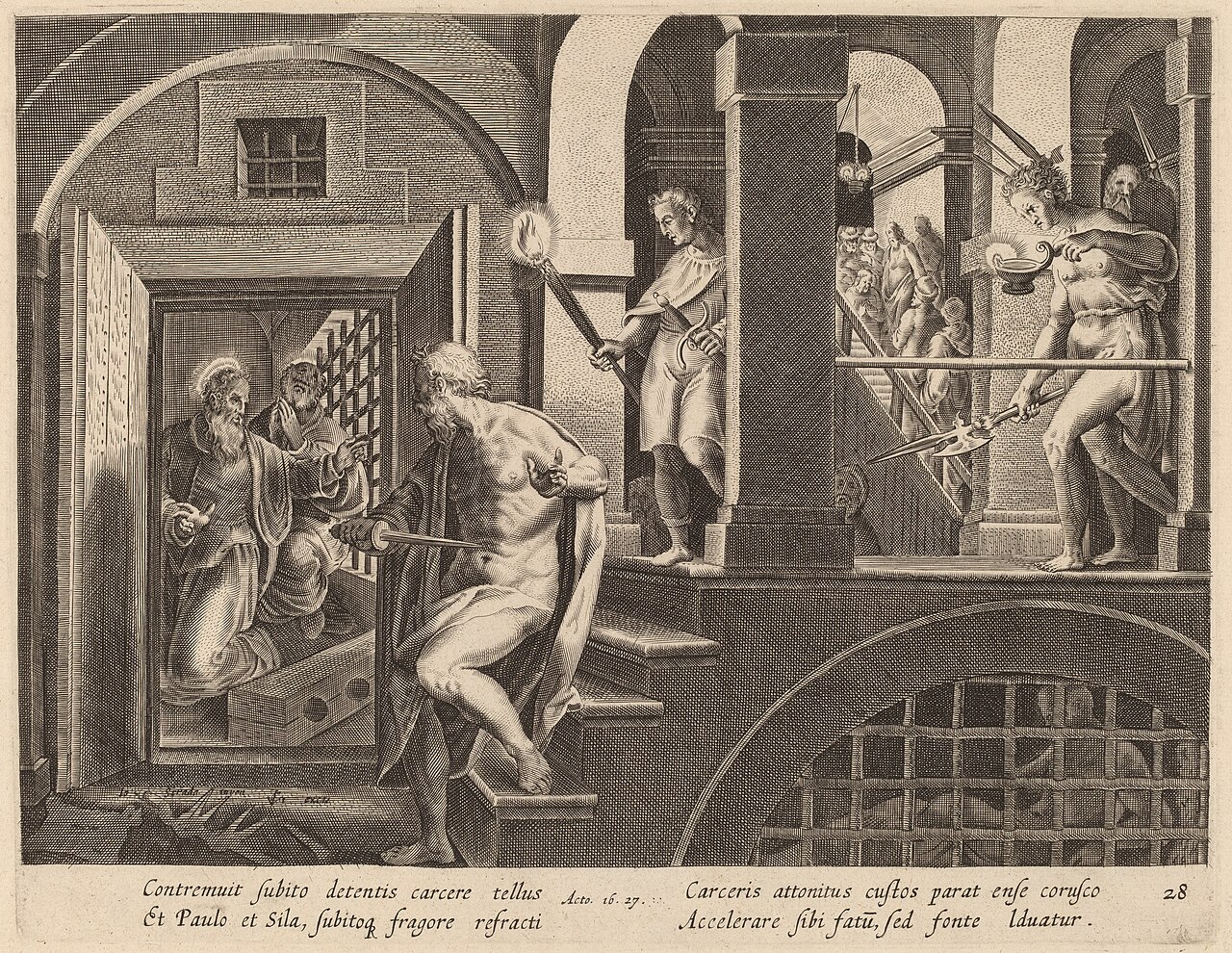
He was a functionary doing his job thoroughly: ordered to keep Paul and Silas safely, he “put them into the inner prison and fastened their feet in the stocks” (Acts 16:23-24). At midnight the strangest sound in his career drifted up from that inner cell – flogged men singing hymns – and then the earthquake: doors open, bonds unfastened, and a career man’s world in ruins. Roman jailers paid for escapes with their lives; his sword was already drawn when a voice shouted through the dark, “Do not harm yourself, for we are all here” (Acts 16:25-28).
The prisoners had not run – for his sake – and the jailer, trembling with torch in hand, fell down and asked history’s most direct question: “Sirs, what must I do to be saved?” The answer is the gospel with no packaging: “Believe in the Lord Jesus, and you will be saved, you and your household” (Acts 16:29-31).
Grace made him gentle before dawn. The man who had locked bleeding prisoners in stocks “took them the same hour of the night and washed their wounds” – the jailer nursing his prisoners – was baptized with his household, “and rejoiced along with his entire household that he had believed in God” (Acts 16:33-34). Philippi’s founding membership now held a merchant woman, a freed slave girl, and a Roman jailer: the letter to that church would later say there is one body across every line, and its first roll already proved it.
In the New Testament
- The earthquake and the question (Acts 16:25-34)
Key Locations
- Philippi The Roman colony in Macedonia -- Lydia, the jailer, the midnight hymns, and Paul's most joyful letter.