
Mount Sinai
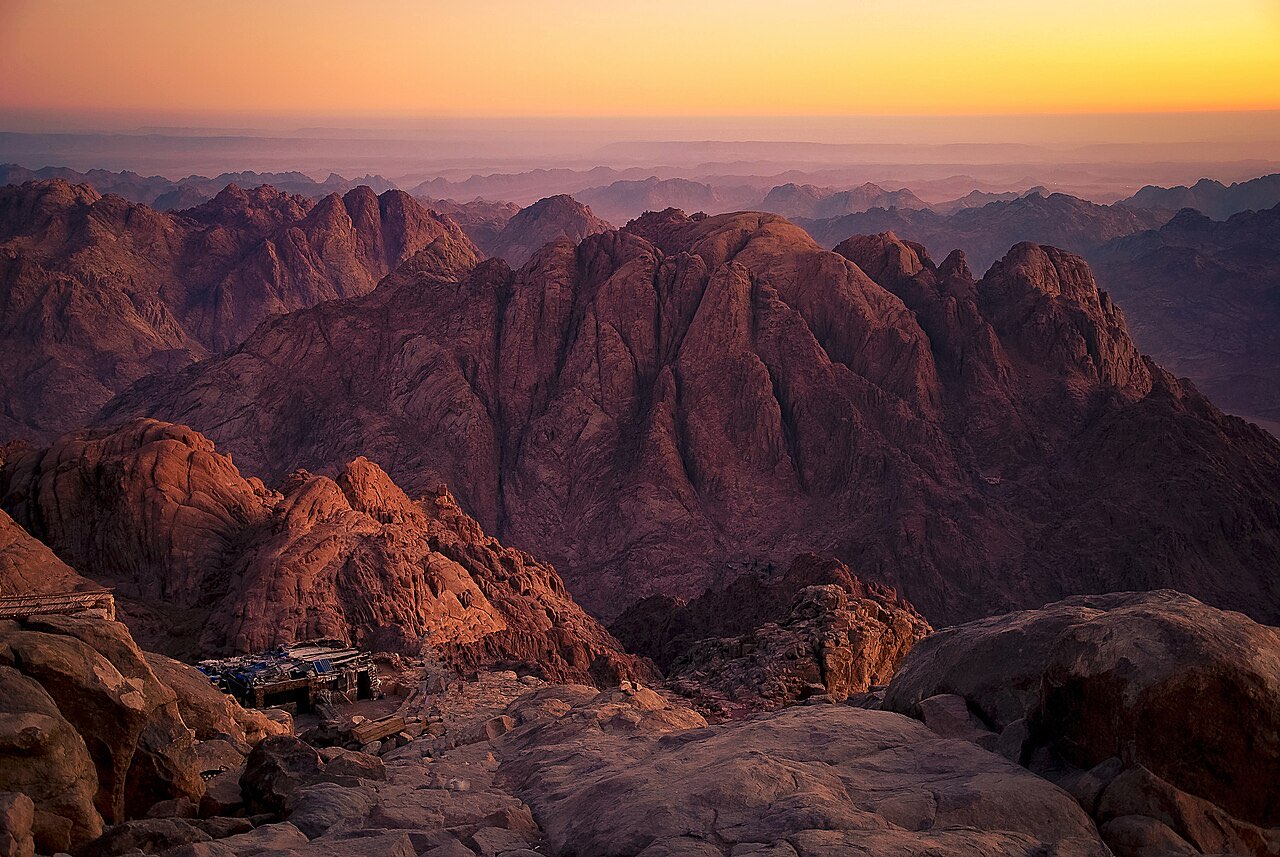
Sinai lies far off this map’s southern edge, deep in the granite wilderness of the peninsula that bears its name – since the fourth century identified with Jebel Musa, “the mountain of Moses,” where St. Catherine’s Monastery keeps watch. Here God spoke the Ten Words out of fire and cloud, cut covenant with Israel, and made the mountain itself so holy that a beast touching it died (Exodus 19-20). Israel’s forty wilderness years began at its foot – the golden calf, the tabernacle, the long schooling of a rescued people.
The New Testament keeps returning to that mountain to explain what Christ has changed. Paul makes Sinai the allegory of the covenant of slavery, over against “the Jerusalem above” who is free (Galatians 4:21-31). Writing to Corinth, he holds up the wilderness generation – baptized in the sea, fed with manna, and overthrown – as a standing warning: “these things took place as examples for us” (1 Corinthians 10:1-13). And Hebrews stages the whole contrast in one paragraph: “You have not come to what may be touched, a blazing fire and darkness and gloom and a tempest… But you have come to Mount Zion and to the city of the living God” (Hebrews 12:18-24).
Sinai is not abolished in that telling; it is answered. The mountain that said “do not come near” is fulfilled at the mountain that says “draw near.”
In the New Testament
- Stephen retells the Sinai story (Acts 7:30-44)
- The Hagar-Sinai allegory (Galatians 4:21-31)
- The wilderness generation as warning (1 Corinthians 10:1-13)
- Sinai contrasted with Zion (Hebrews 12:18-24)