
Corinth
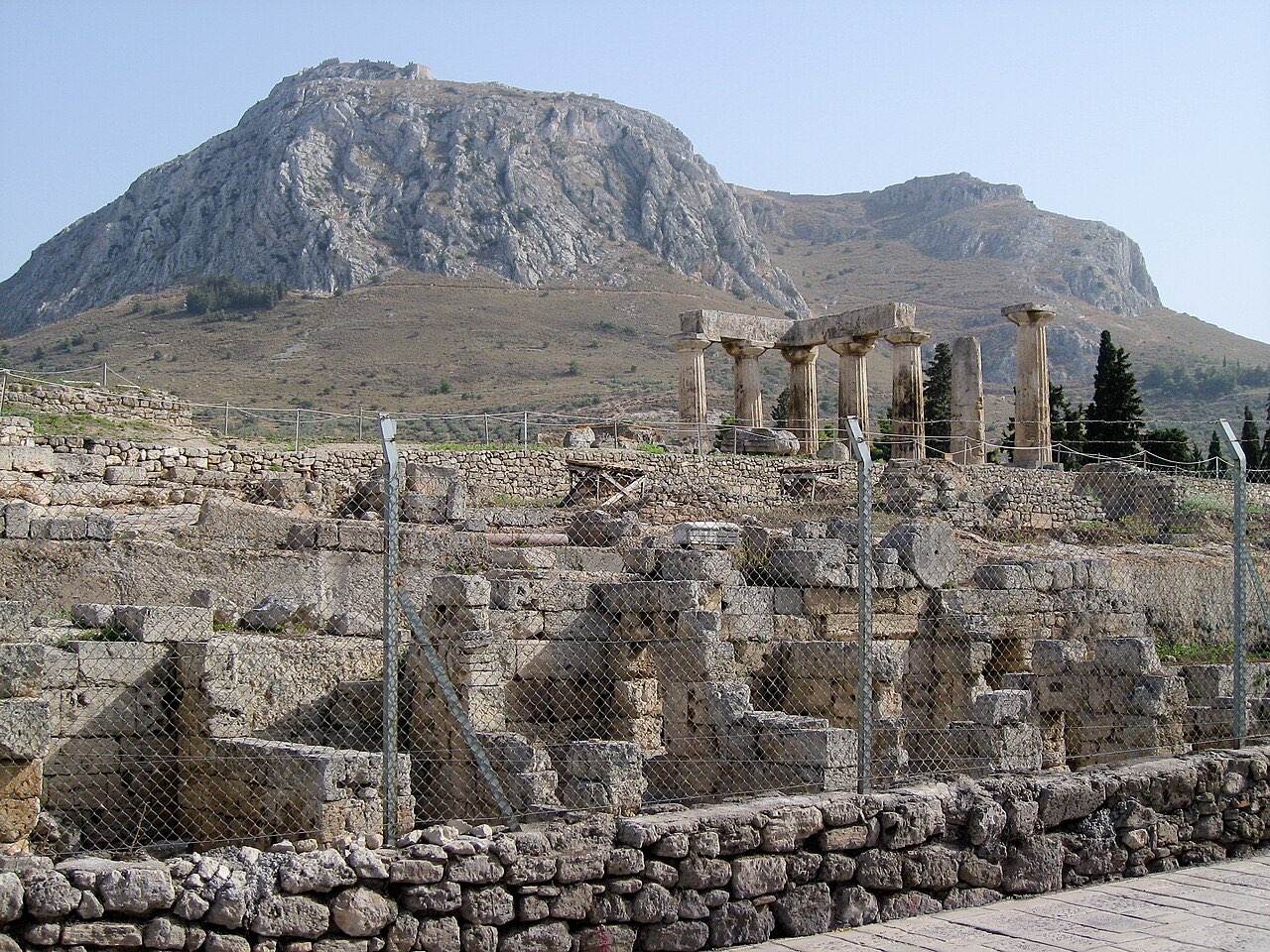
Corinth owned the crossroads of Greece: the narrow isthmus where east-west shipping was hauled overland between two seas, and the north-south land route crossed it. Destroyed by Rome and refounded by Julius Caesar as a colony, the city Paul entered was young, rich, competitive, and famously loose – a boom town of freedmen, sailors, bankers, and patrons, capital of the province of Achaia, overlooked by the crag of Acrocorinth.
Paul came from Athens “in weakness and in fear and much trembling” (1 Corinthians 2:3), found tentmaking partners in Aquila and Priscilla, and stayed eighteen months on the strength of a night vision: “Do not be afraid… for I have many in this city who are my people” (Acts 18:1-11). When the synagogue’s opposition hauled him before the proconsul Gallio’s tribunal – the excavated bema still stands in the forum – Gallio threw the case out, a precedent that sheltered the mission for years (Acts 18:12-17).
The church that grew in that soil was gloriously alive and endlessly in trouble: factions, lawsuits, immorality, chaos at the Lord’s Supper, confusion about resurrection. Paul’s letters to Corinth run longer than to any other church, and contain some of his highest peaks – the word of the cross (1 Corinthians 1), the love chapter (1 Corinthians 13), the resurrection chapter (1 Corinthians 15), and the theology of strength perfected in weakness (2 Corinthians 12). He wintered in Corinth again on his last journey and from there wrote Romans, with Cenchreae’s deacon Phoebe as its carrier (Romans 16:1-2).
In the New Testament
- Eighteen months of ministry; Gallio’s ruling (Acts 18:1-18)
- The letters: 1 and 2 Corinthians
- Apollos waters what Paul planted (Acts 18:24-19:1; 1 Corinthians 3:6)
- Romans written from Corinth (Romans 15:25-16:2)