
Bethlehem
Bethlehem (“house of bread”) sits on a ridge about six miles south of Jerusalem, on the edge where farmland gives way to the Judean wilderness. Long before the manger, it carried a heavy history: Rachel was buried nearby (Genesis 35:19), Ruth gleaned in its fields, and its most famous son, David, was anointed king there while still a shepherd boy (1 Samuel 16). That is why Micah’s prophecy lands with such precision: “But you, O Bethlehem Ephrathah, who are too little to be among the clans of Judah, from you shall come forth for me one who is to be ruler in Israel, whose coming forth is from of old, from ancient days” (Micah 5:2).
A Roman census brought Joseph and the expectant Mary from Nazareth to this ancestral town of David, and the King of the universe was born in its most humble quarters, laid in a feeding trough, and announced to night-shift shepherds (Luke 2:1-20). Magi later found the child here – and Herod’s paranoia turned the little town into the scene of the massacre of the innocents (Matthew 2).
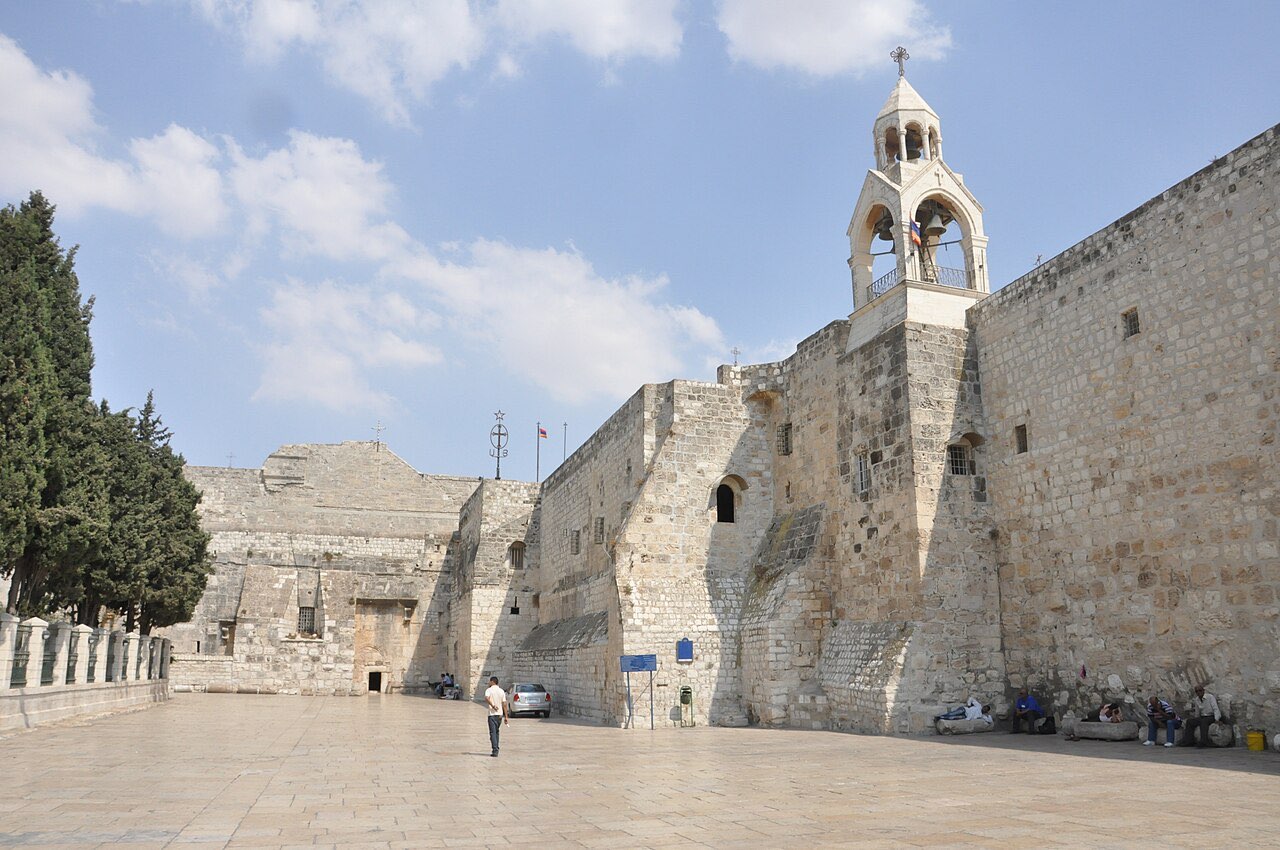
The Church of the Nativity, first built by Constantine in the fourth century and rebuilt by Justinian in the sixth, still stands over the grotto. Its main door was long ago shrunk to the “Door of Humility,” barely four feet high: every visitor bows to enter the place where God stooped to be born.
In the New Testament
- The birth of Jesus and the shepherds’ visit (Luke 2:1-20)
- The visit of the magi (Matthew 2:1-12)
- Herod’s massacre of the innocents (Matthew 2:16-18)
- The crowd’s debate: “Does not the Scripture say the Christ comes from Bethlehem?” (John 7:42)